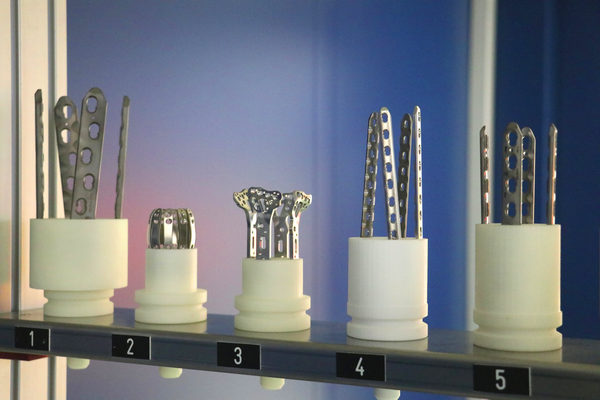
Bone implants represent a Swiss success story spanning more than 60 years. “In Switzerland, surgical treatment of bone fractures was advanced and standards were set that are recognized worldwide. Working with the country’s precision manufacturing industry, implant designs were developed that are still relevant today,” says Lorenzo Zoccoletti, CEO of Genostis, based in Burgdorf in the canton of Bern. “We are continuing this tradition with a generic bone implant system produced 100% in Switzerland to the maximum dimension of quality.”
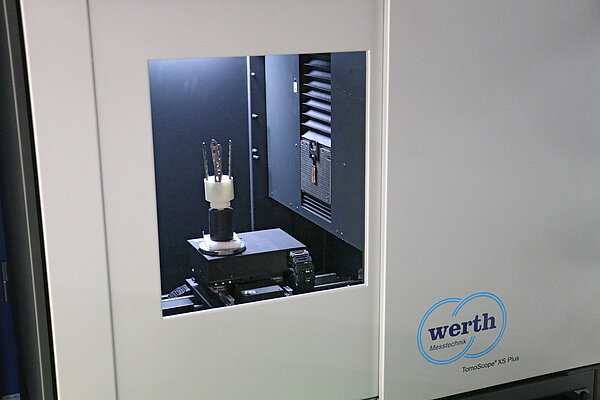
The TomoScope XS Plus 160 scans four titanium implants in about ten minutes.
In this context, “generic” means that Genostis implants – —inspired by generic drugs in the pharmaceutical industry – —are based on well-known designs that are now patent-free. Thanks to the generic principle, research and development costs are negligible. “Our plates and screws are based on designs that have been proven over decades. Through an in-house reengineering process, we optimize them to meet today’s requirements for patient-friendly use and efficient manufacturing,” explains Zoccoletti. The president points out that the prices for his generic implants are significantly lower than those of other well-known suppliers, without having to compromise on quality. “This allows us to ensure the highest possible product safety and compete with the leading suppliers,” says Zoccoletti.
Since the largest cost component arises during production, those in charge there focus on achieving very high efficiency. “We have very high labor costs here in Switzerland,” says Carmelo Blandini, COO of Genostis. “That’s why highly automated production processes and the intelligent use of innovative production equipment are crucial to our success.”
A core element of production is metrology. “All of our implants must meet the strict regulatory requirements for medical devices, including the applicable EU Medical Device Regulation (MDR) 2017/745,” explains Zoccoletti. “The CE mark is a prerequisite for marketing an implant in the EU. To obtain it, we must provide various forms of evidence, which are tested by a certification body.”
In addition to extensive validation measures, certain measurement tasks are unavoidable, such as the initial sample inspection of individual products. In addition, measurements close to production are required, which Genostis has consistently automated and integrated into production. “For our concept, computed tomography seemed to us to be the most suitable measurement technology,” explains Blandini. He ruled out conventional tactile 3D coordinate metrology for various reasons: The time and cost required for the necessary fixtures and measurements are enormous, and the test specimens would have to be positioned manually. An industrial CT machine, on the other hand, offers much better conditions for achieving the desired high level of automation.
The Genostis management team opted for the Tomo Scope XS Plus 160 from Werth Messtechnik. “We were familiar with Werth as a renowned provider of metrology solutions that has long offered coordinate measuring systems for industrial computed tomography,” said Blandini. The selected Tomo Scope XS Plus 160 meets all the basic requirements for reliable and quick measurement of Genostis implants. It enables the scanning of small and medium-sized workpieces up to approximately 300 mm in diameter and 450 mm in length. A key component is the transmission tube in a monoblock design, which enables a small focal spot even at high tube power, allowing for fast measurements with high resolution.
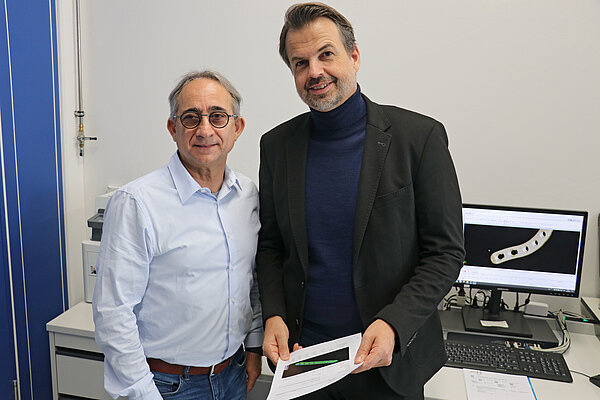
Genostis COO Carmelo Blandini (left) with Werth Sales Manager Detlef Ferger: “With the support of Werth’s CT specialists, we have developed a great deal of expertise and tailored the measurement process precisely to our titanium workpieces.”
Tube voltage allows for the measurement of titanium plates
The machine’s maximum tube voltage is 160 kV. This enables the measurement of workpieces with greater radiographic lengths and denser materials. “Since we need to capture the geometries of titanium plates and screws, this was an important deciding factor,” explains Blandini. However, he also points out that the required cycle time for production monitoring posed a challenge, as short capture times for the workpieces are essential. “We had to invest some time before we gained the necessary experience with the CT sensor.” This is because Genostis wanted, for example, to scan the titanium workpieces in multiple orientations. “Since the measuring objects influence each other during the measurement process, which can lead to image errors—so-called artifacts—we conducted numerous tests regarding the number of parts and their positioning relative to one another in order to achieve good results,” explains Dusan Mirkovic, Head of Production & Automation. “The CT specialists at Werth actively supported us with their expertise, enabling us to gain a great deal of know-how and ultimately develop measurement strategies tailored precisely to our products.”
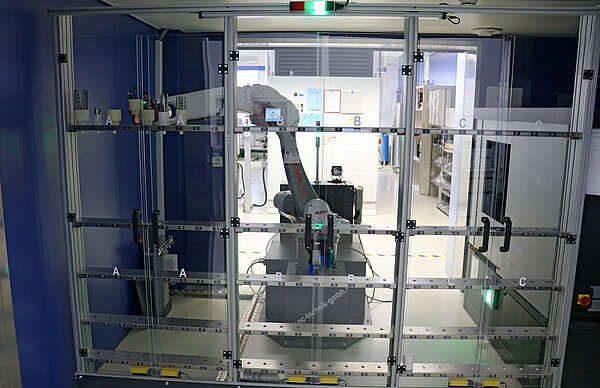
The measurement cell at Genostis consists of a Tomo Scope XS Plus 160 (right). A second Tomo Scope is to be added on the left side. The robot will then operate both CT machines from the rack visible in the foreground, which has 135 fixture stations.