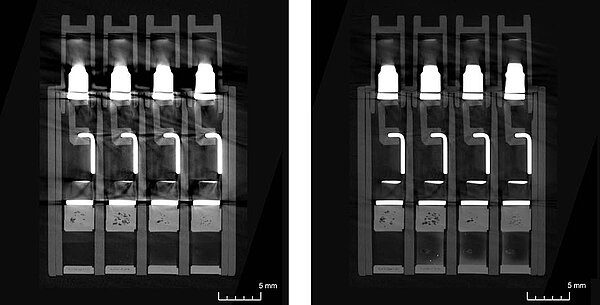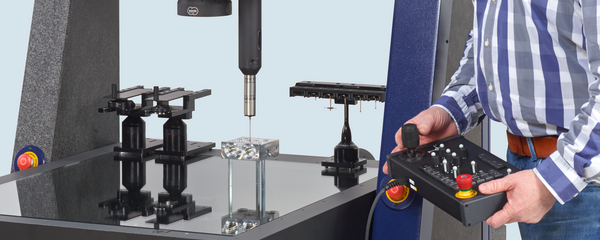



The continuous reduction of systematic deviations in computed tomography (CT) – of so-called artifacts – is one of the development priorities for the WinWerth® measurement software. As early as 2005, correction methods were integrated into the reconstruction of the digital workpiece volume in the world's first machine with X-ray CT specially developed for coordinate metrology, the TomoScope® 200.
To extend the range of applications of the machines, it is not enough to measure plastic workpieces quickly and accurately. Complex assemblies with highly absorbent materials such as metals or ceramics and, for example, combinations of plastic and copper must also be analyzed and measured highly accurately. When scanning tomographically such multi-material workpieces, however, significantly stronger artifacts occur, for example due to beam hardening, which significantly impair the measurement accuracy and even make inspection impossible in some cases.
Accuracy and efficiency go hand in hand
To meet these challenges, various correction methods have been integrated into WinWerth®. Empirical Artifact Correction (EAC), which has been tried and tested for decades, enables the correction of unknown artifacts on the basis of a single tomography scan, but has so far been limited to use for mono-material workpieces. Alternatively, multi-spectral CT (MSP-CT) provides very good results by means of two measurements with different X-ray spectra, even for multi-material workpieces, but at the expense of measurement time. With the new MEAK (multi-material EAK), artifact-generating areas (e.g. metal contacts in connectors) are automatically detected according to a measurement, and the artifacts generated are determined and removed. The result is a corrected volume with significantly reduced artifacts, which usually allows reliable measurement and analysis.